The Marais feeds you well if you know where to look. Not in the tourist restaurants with photographed menus at the corner of the rue de Rivoli, but in the Jewish quarter, in a covered market that has been standing since 1615, and in a handful of small shops that most visitors walk straight past. This is my guide to eating in the Marais the way people who actually live here eat.
Two sections, one neighbourhood. The Jewish quarter in the south, the Haut Marais in the north. Walk between them and you have one of the best food routes in the city.
L'As du Fallafel €
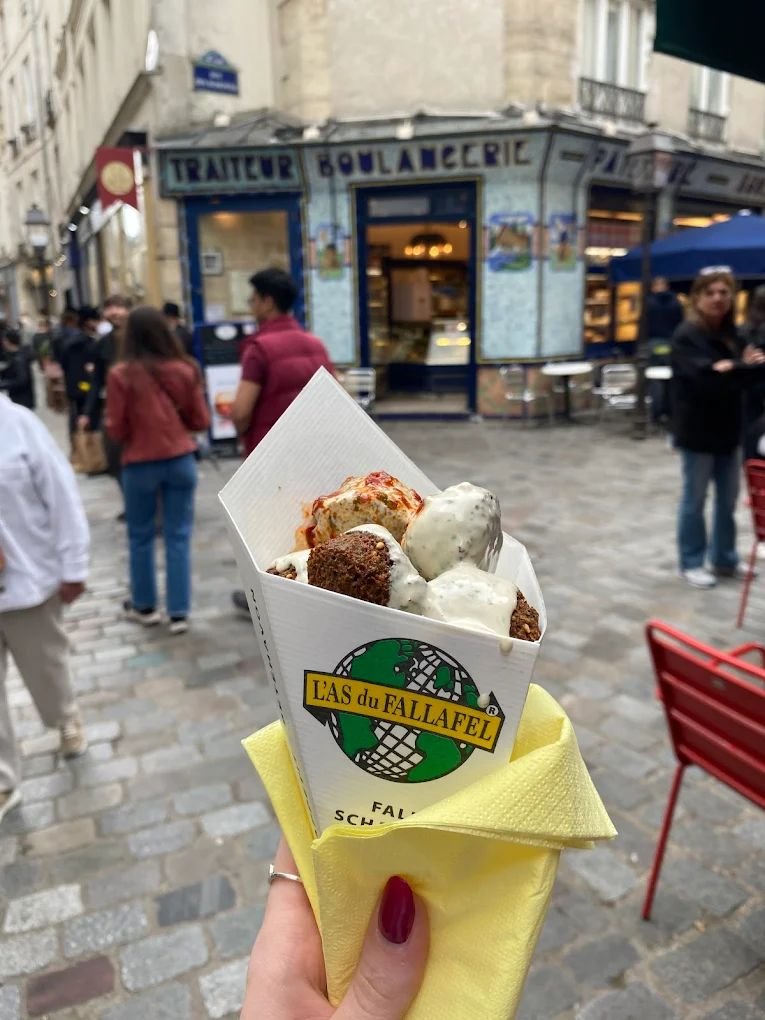
Yes, everyone knows L'As du Fallafel. It appears in every guidebook, every food blog, every Paris video on YouTube. And yet it remains worth it. Isaac and Daisy Peretz founded a small grocery selling falafels here in 1979. The sandwiches became so popular that the shop gradually added tables and became a full restaurant by 1997. What started as a neighbourhood counter is now a Paris institution, but the pita itself has not changed: fried chickpea balls, grilled aubergine, tahini, and cabbage, all pressed into warm bread that is just thick enough to hold together under the pressure of eating it.
The honest answer is that the queue at lunchtime on a weekday is real, and the experience is not exactly intimate. But the quality is consistent in a way that genuinely famous places often are not. Order at the takeaway window, not inside, and walk ten minutes to the Place des Vosges to eat on a bench. That combination is hard to argue with.
Miznon €€
Two streets from L'As, and operating on a completely different philosophy. Miznon opened here in 2013, bringing Israeli street food directly from Tel Aviv into the heart of the Marais Jewish quarter. The concept is built around the pita, combining the creativity of the Levantine kitchen with high-quality French ingredients. The chef behind it is Eyal Shani, a prominent figure in Israeli gastronomy.
The menu changes and is scrawled on a blackboard rather than printed, which tells you something about the approach. The lamb and beef meatball pita is the thing most people order. The whole roasted cauliflower, served as a side, has become something of a signature: blasted in a very hot oven, finished with olive oil and sea salt. It sounds like nothing and tastes like a great deal. Where L'As is a classic, Miznon is restless. It is worth going to both.
Florence Kahn €€
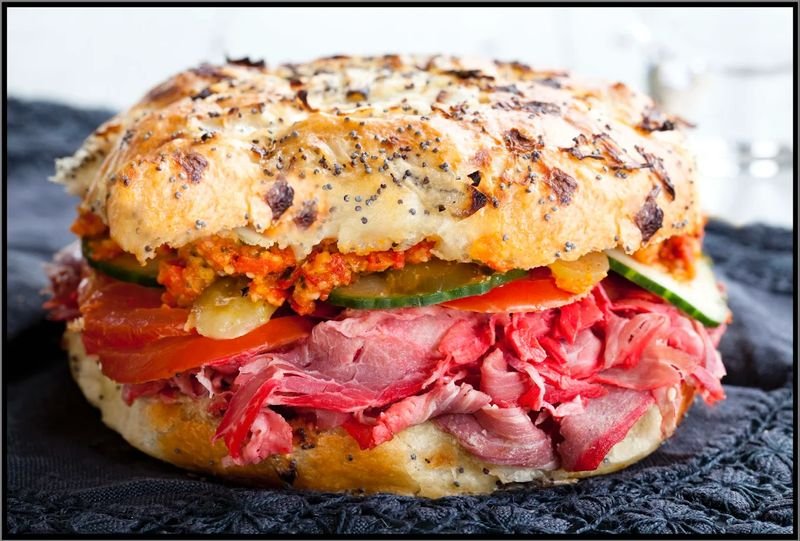
Three doors from Miznon, recognisable immediately by its blue mosaic facade. The shop is classified as a Historic Monument, dating to 1932. It is a bakery, pâtisserie and delicatessen specialising in Ashkenazi Jewish cuisine from Eastern Europe: bagels, hallot de Shabbat, pastrami, pikelfleish, strudels, cheesecake, cornichons Malossol brined for months.
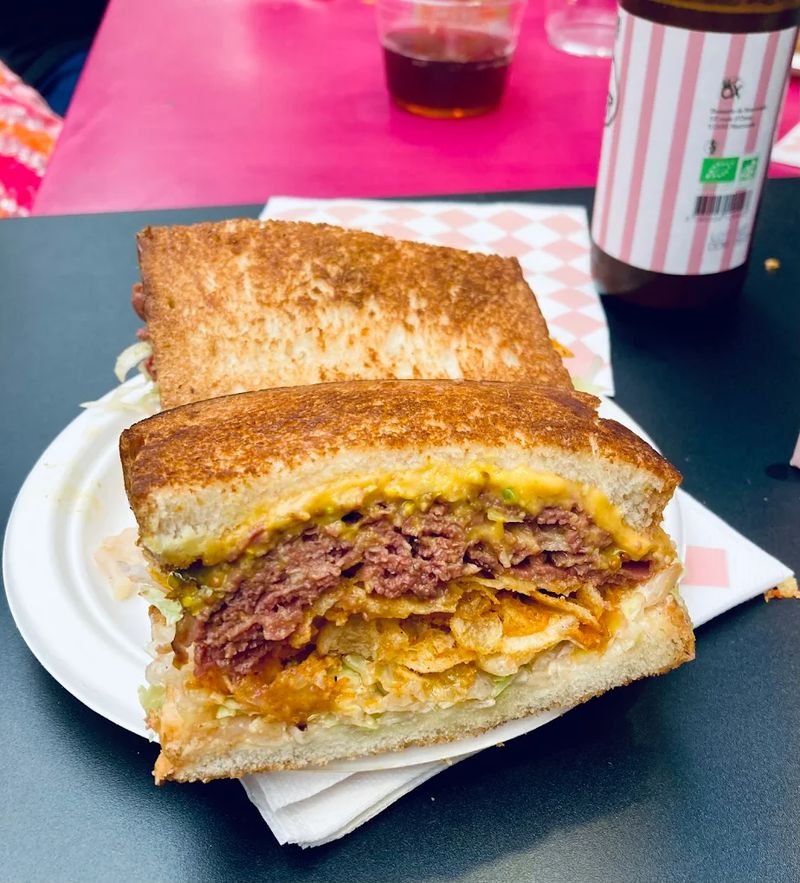
This is the address for anyone curious about Yiddish food beyond the falafel. The pastrami sandwich, served in a cumin roll or a poppy seed pletzel, comes layered with pickled peppers, aubergine caviar, and those cornichons. The foie haché sandwich is equally serious. Florence Kahn is not trying to appeal to everyone. It is doing something specific and doing it very well, which is a more interesting position than most places manage.
Brigat' Gelato €€
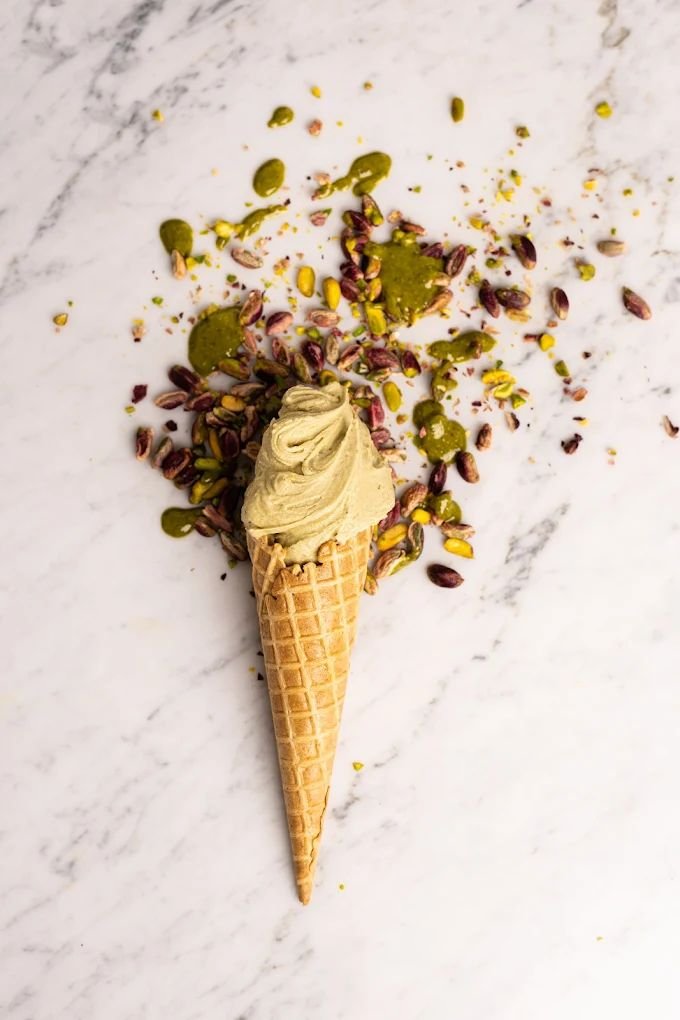
You already know Brigat’ if you have read my pâtisseries guide. Lucio and Thomas Colombo, two Italian brothers, opened this shop a minute's walk from the Place des Vosges, working squarely within the French pastry tradition while drawing on Italian sourcing: Sorrento lemons, Iranian pistachios, a panettone available year-round. For street food purposes, the move here is the gelato counter. The flavours are seasonal and made in small batches.
Buy a cone, walk to the Place des Vosges, find a bench under the arcades. There are worse ways to spend a Tuesday afternoon in Paris. If you are there in the morning, the tarte noisette or the seasonal fruit tart is the thing to eat standing at the counter.
Princess Crêpe €
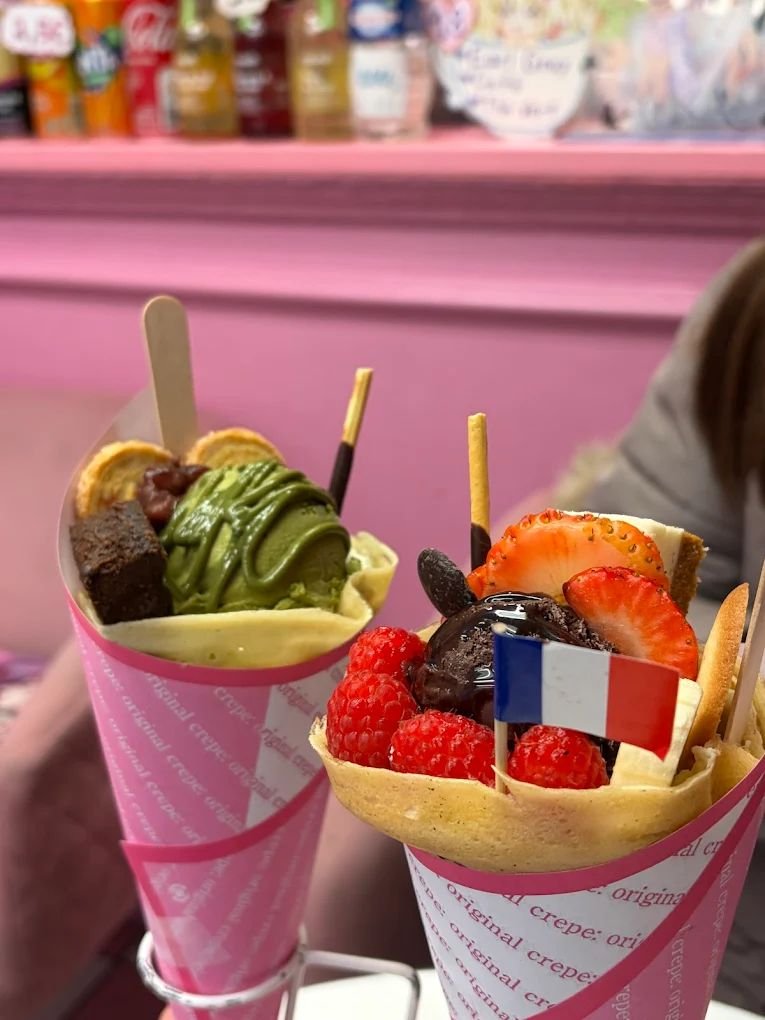
I will be honest: the maid café aesthetic is not naturally my thing. The pink walls, the heart-shaped window, the rabbit ears. I went out of curiosity, half expecting to walk back out after thirty seconds. I did not walk back out. The owner, Japanese, runs this place with a precision that has nothing to do with the decor and everything to do with the craft. He has been making these crêpes since 2011, and it shows.
The crêpes here are in the Harajuku style: rolled into a cone, layered generously with creams, fruits, and garnishes that should not hold together but somehow do. The execution is careful in a way that most crêpe stands are not. But the thing that genuinely stopped me was the hot chocolate. Made without milk, barely sweetened with black honey from Hokkaido, it was one of the best I have had in Paris. A completely unexpected ending to a visit I had almost not made.
Homer Lobster €€
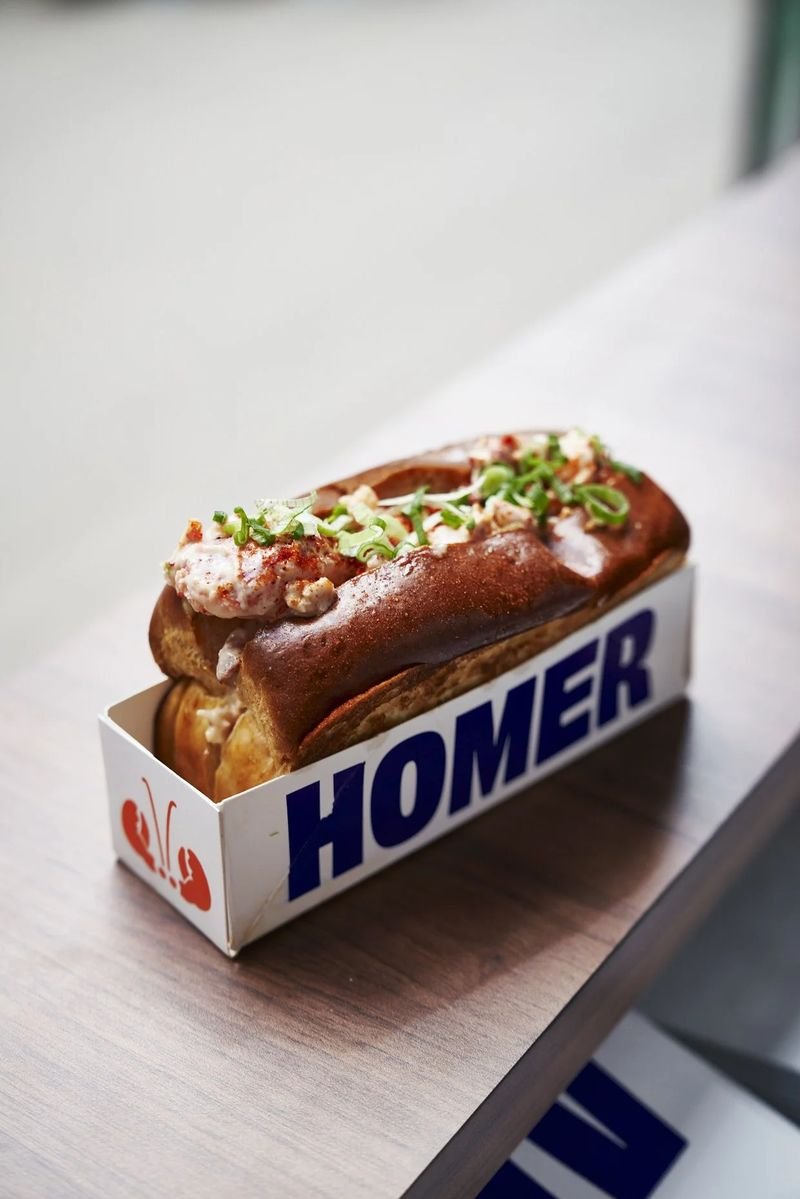
Just behind the Centre Pompidou, at the junction where the Marais meets the Beaubourg, Homer Lobster does one thing: the New England lobster roll. Two versions, classic and Connecticut. The classic is cold lobster with house mayo. The Connecticut is warm lobster with lemon butter and herbs. Both come in a toasted brioche bun that is properly made. In 2018, they won the jury prize at the Down East World Lobster Roll Championship in Portland, Maine, which is not the kind of thing you make up.
At around 22 euros, it is the most expensive item in this guide. But it is also the most luxurious, and the contrast with an 8-euro falafel eaten thirty minutes earlier is part of what makes a day in the Marais so satisfying. This is the deliberate splurge, the one you budget for.
A ten-minute walk north from rue des Rosiers takes you out of the 4th and into the 3rd arrondissement, where the rue de Bretagne runs through a neighbourhood that still does its food shopping on foot. At number 39, easy to miss from the street, is the entrance to the oldest covered market in Paris.
The Marché des Enfants Rouges has been here since 1615. It takes its name from the orphanage that once occupied the site, whose children wore red uniforms. It was nearly demolished in the 1980s and saved by the local residents who refused to let it go. Today it is a small, dense, atmospheric space with a slate roof, communal wooden tables, and a collection of food stalls that span Moroccan tagine, Japanese bento, Lebanese meze, and several things that are specifically French.
Caractère de Cochon €€
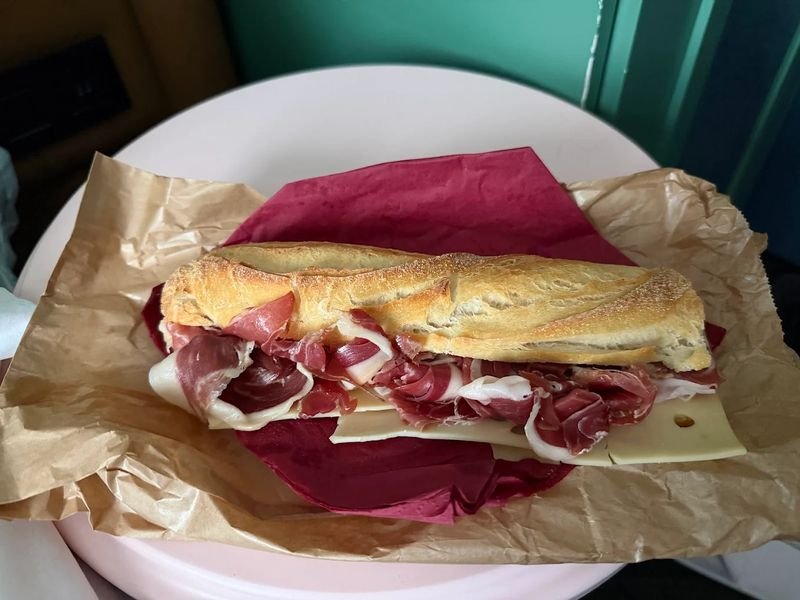
The maroon facade, the hams hanging in the window, the smell when you open the door: Caractère de Cochon is one of those shops that declares itself immediately. Solo Raveloson, the owner, has filled the space wall to wall with charcuterie from France, Italy, Spain and elsewhere. Jambon blanc de Paris, jambon fumé aux foins from the Vosges, Corsican cured ham, lardo di Colonnata, Black Bigorre pork fed on chestnuts and acorns. The range is serious and the sourcing is genuine.
The sandwich is made to order: you choose your ham, your cheese if you want one, the bread. A baguette tradition, generously buttered, with a few slices of aged ham cut to order. This is the jambon-beurre taken seriously. It is more expensive than a boulangerie version and it is noticeably better.
Chez Alain Miam Miam €
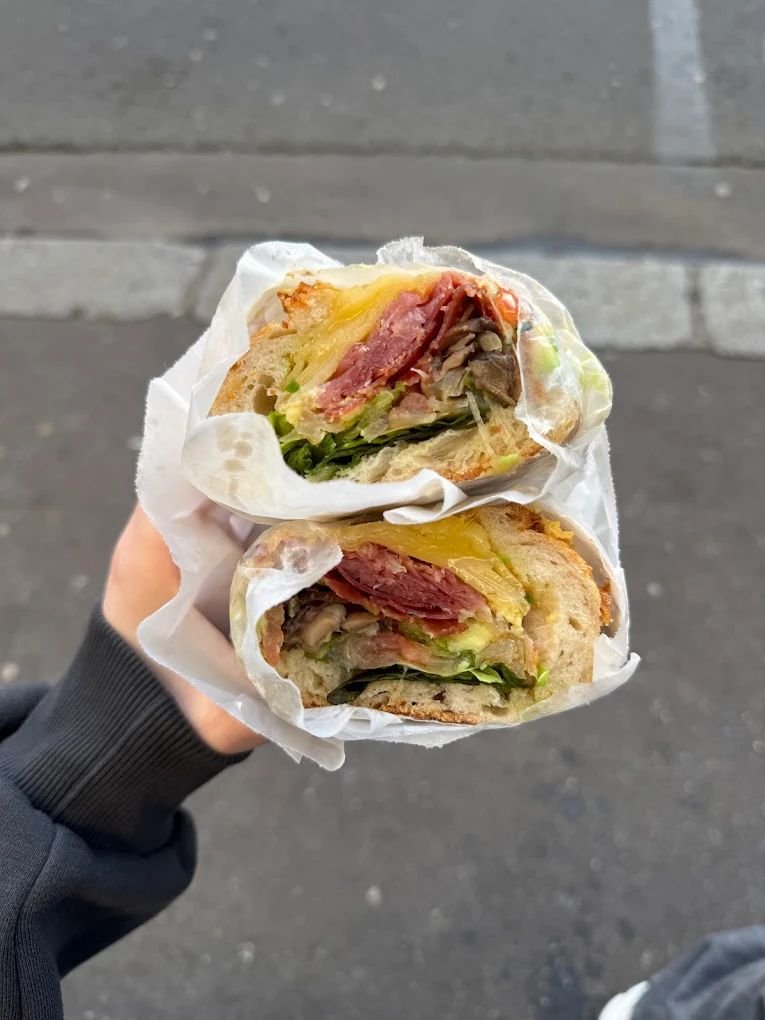
Alain Roussel started at a single stand inside the Marché des Enfants Rouges in 2005. The concept was simple: sandwiches and galettes made to order, on the spot, in front of you, with organic ingredients. When demand outgrew the market stall, he opened a dedicated address on rue Charlot in 2010, now run by his son. The stand inside the market has since passed to new hands, but the rue Charlot address carries the original spirit.
The sandwich is a performance as much as a meal. You choose your ingredients from a list, and Alain builds them in front of you: salad, caramelised onions, mushrooms, avocado, chives, a quantity of comté or cantal that seems impossible, and your choice of ham, pastrami, spiced chicken, or smoked trout. The whole thing is then pressed briefly on a hot plate. The result should not hold together but somehow does. It is enormous, it is messy, and it is excellent.
Lulu Crêperie €
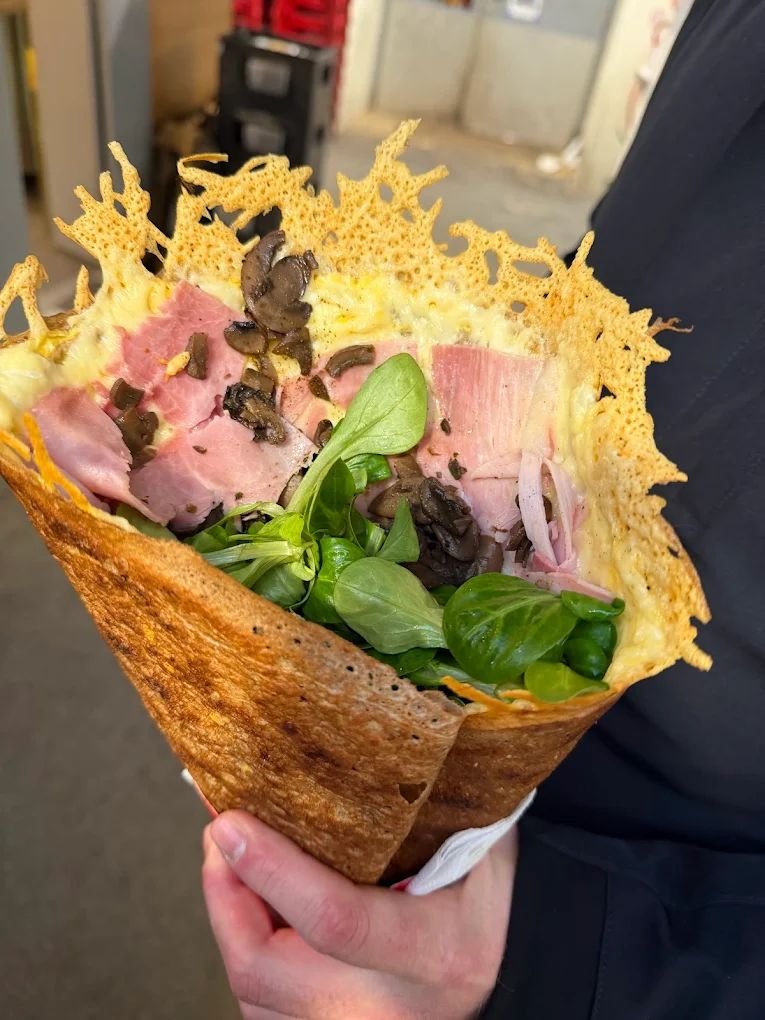
Since February 2025, Lulu Crêperie has occupied the stand inside the Marché des Enfants Rouges where Alain Miam Miam had made his name. Lucien, the young owner behind the nickname, works with organic stone-ground Breton buckwheat flour and produces galettes that have quickly become a fixture of the market's lunchtime rhythm. The dough crisps at the edges and stays soft at the centre.
The fillings combine the traditional with less expected combinations: beef with spices, pesto rouge, seasonal vegetables alongside the classic ham and melted cheese. For dessert, the salted butter caramel crêpe is what most people around you will be eating. It is a young address with no long history behind it yet, which means it still has something to prove. So far, it is proving it consistently.
Dumbo €
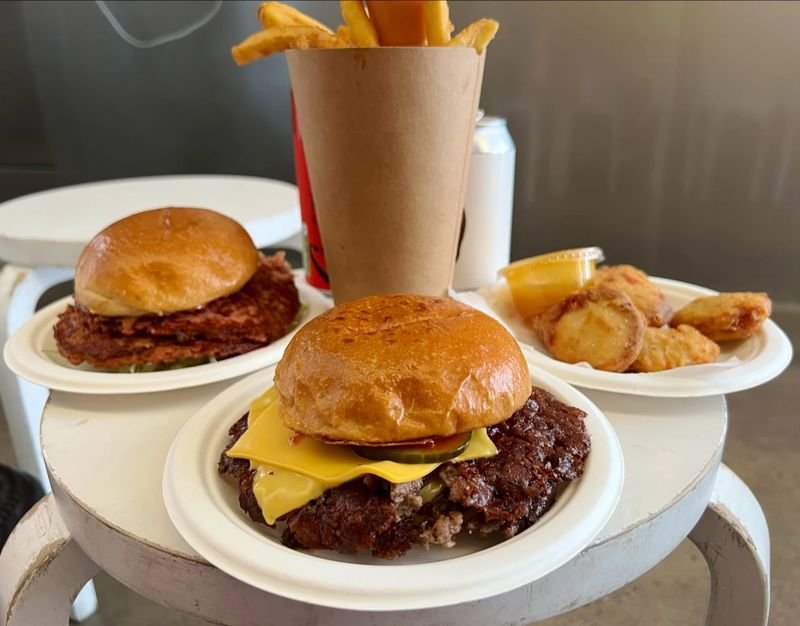
Behind the minimal facade on rue de Poitou is the Marais outpost of the address that changed how Paris thinks about burgers. Charles Ganem and Samuel Nataf opened their first Dumbo in Pigalle in 2019 with a specific aim: to bring the smash burger technique, then little known in France, to Paris. A patty of beef pressed hard onto a very hot plancha, caramelised at the edges, thin and crisp and juicy. The Fooding guide named it best burger in France in 2020.
The menu is short: cheeseburger (10 euros), veggie burger (13 euros), frites (4 euros). Nothing else. That restraint is the point. Every element has been worked on for months: the potato bun, the pickles, the beef. This is the address where the day in the Marais ends well, especially after the richness of a pastrami sandwich or a lobster roll earlier.